A book by Jules Petroz
Un Manet si bien caché
Histoire d'une découverte — Récit
Éditions Le Manuscrit · 2009
A first-person narrative in which Geneva art dealer Jules Petroz recounts his life in the trade — and the day a worthless pastel bought for fifteen francs at the Plainpalais flea market revealed, beneath its paper, an oil painting he believes to be by Édouard Manet.
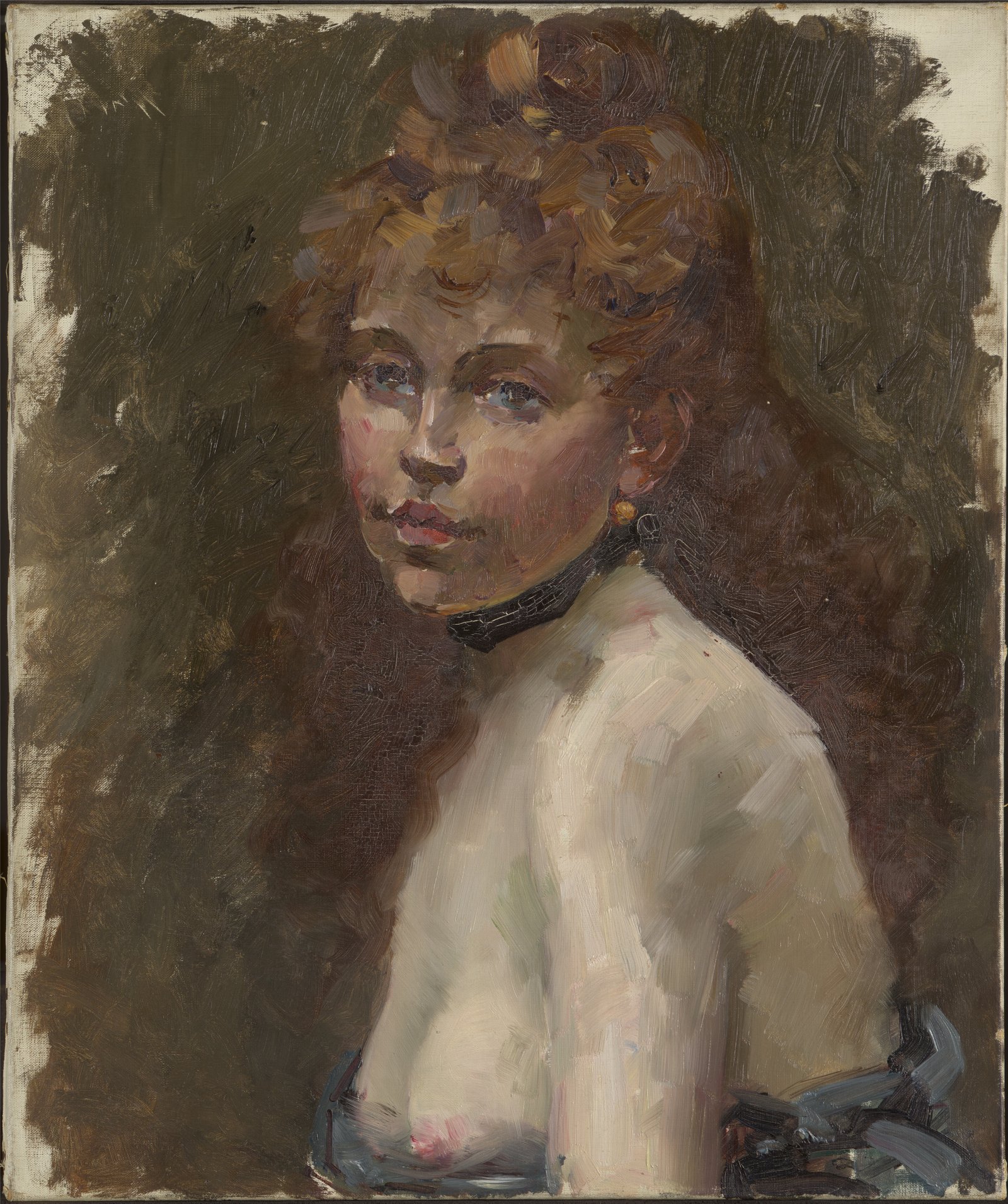
The discovered oil painting — a nude young woman with auburn hair, which Jules Petroz attributes to Édouard Manet.
The book
A dealer’s memoir, and the chase of a lifetime
Part memoir, part art-historical investigation, the book follows Jules Petroz from a childhood among Carouge antique dealers and restorers to four decades of hunting drawings, books and paintings across the flea markets, auction rooms and museums of Europe, New York, Russia and China.
At its heart is a single, extraordinary episode: the discovery, on 8 April 1997, of a hidden painting — and the long, stubborn quest to have it recognised. It is a story about connoisseurship, provenance and the closed world of the experts, told by a dealer who refused to take no for an answer.
8 April 1997 · Plainpalais, Geneva
A painting hidden under a pastel
Strolling the Plainpalais flea market, Jules and his wife Aïcha stop at the stand of a friend. Two mediocre pastel portraits, leaning against a telephone booth for months and ignored by everyone, catch his eye — not for the pictures themselves, but for the wooden stretcher behind one of them, which he hoped to reuse.
A tear in the corner of the pastel revealed a glimpse of brownish paint beneath. Curious, he bought it for fifteen francs — all the money the couple had between them — and peeled back the paper. Beneath lay a nude young woman with auburn hair, pearly skin, a dog collar and earrings, painted in oil on a dark ground.
The investigation
Reading the canvas
Trained in restoration and art history, Petroz read the painting as a connoisseur. The “Louis XV” grey-blue, the absolute black diluted with turpentine and crackled in a way peculiar to Manet, the flat brushwork laid without repentir, the untouched edges, the dog collar fashionable in the master’s last decade — each detail pointed to Édouard Manet.
A stamp on the stretcher, “Gay, avenue de Villiers”, led to a Paris colour merchant who traded near Manet’s studio between 1879 and 1898. The format matched the size Manet used for his studies. Yet the only authority able to authenticate a Manet — Daniel Wildenstein — replied that it was “a later painter, around 1900”, without ever asking to see the canvas.
Refusing to give up, the Petrozes turned to the press, the public and the courts of opinion: an auction in Geneva, a website, and a media campaign that carried the story around the world. The painting was shown at last; the experts, officially, stayed silent.

The model
A name for the unknown woman
In a bookshop in the summer of 2001, a photograph made the author’s heart race: a young woman, arms crossed over her chest, a black ribbon at her throat — the very face of the painting. Her name was Méry Laurent, a celebrated demimondaine of late-nineteenth-century Paris and the muse and mistress of Édouard Manet.
From that moment, years of archival research followed — in the libraries and museums of Paris, Geneva and beyond — to retrace the life of Méry Laurent and the journey of the pastel that had concealed the canvas, a pursuit the book recounts step by step.


Two portraits of Méry Laurent: the discovered painting and Manet’s known “Méry Laurent au Carlin”, which the author superimposed to confirm the identification.

Scientific analysis
What the scans revealed
Years later, the painting was examined with the multispectral camera invented by Pascal Cotte (Lumière Technology), the instrument that had scanned the Mona Lisa. In false colour, the legendary hair of Méry Laurent appeared woven into the background of the canvas.
An infrared scan at 900 nanometres brought to light the preparatory drawing beneath the paint — hatching in pencil, the eyes, the face, the shoulder — hidden details that no eye could have seen.


A small portrait the author believes may be a Van Gogh self-portrait from the Paris years.

Radiograph of the portrait revealing a repentir: the head was first turned further to the right, leaving two noses and three eyes on the X-ray.
A second discovery
A possible Van Gogh
The book closes with a second, briefer enquiry: a small portrait of a gaunt man under a soft hat, acquired by exchange at the flea market, which the author believes may be a self-portrait by Vincent van Gogh from his Paris years — perhaps, if authentic, a fortieth.
The press
A story that travelled the world
From a first article in Le Matin to features in Paris Match, the AFP and L’Illustré, the discovery was reported across the international press. The book gathers these clippings and archival images — photographs of Méry Laurent, of Mallarmé, and of the pastel that once covered the canvas.


A question about the painting?
Write to PETROZ
Jules Petroz continues to research the painting and welcomes information, archives or photographs relating to Méry Laurent, Élisa Sosset or the work’s history. Every enquiry is read and answered personally, in confidence.
Contact us